
Case studyIllustrative write-up · no real client
A storefront rebuilt for speed and search
A catalogue, cart and checkout rebuilt on a faster foundation, with orders flowing into fulfilment.
- Client
- None: illustrative
- Industry
- Retail and e-commerce
- Screens from
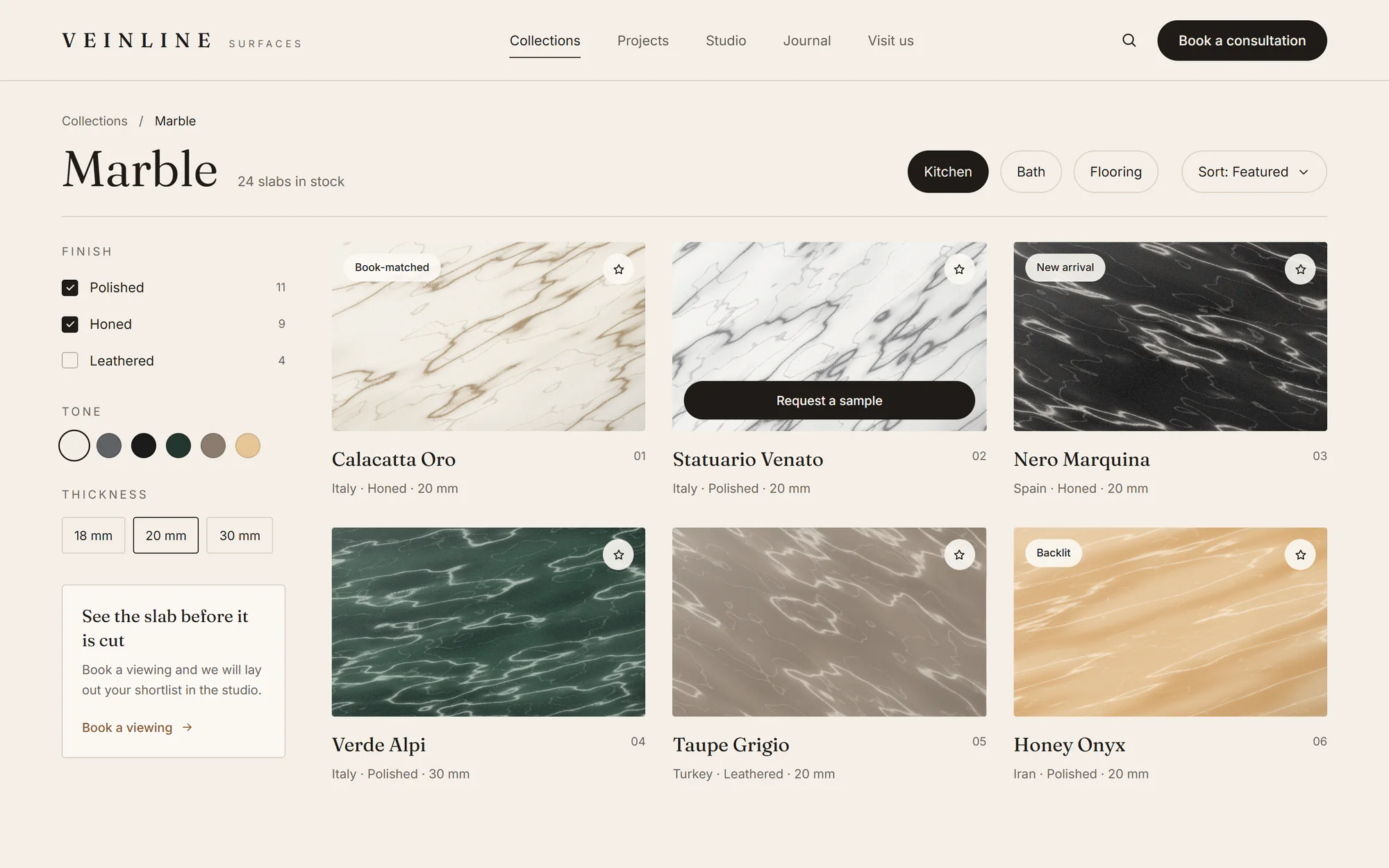
- Veinline Surfaces (concept)


01Challenge
The problem, as it was found
The existing store was slow on phones, hard for staff to update and difficult for search engines to read, and orders were copied into fulfilment by hand.
- Product pages were heavy and slow to load on mobile
- Adding or editing a product needed developer help
- Page structure and metadata worked against search visibility
- Orders were re-entered into the fulfilment system manually
Context
The store had real traffic and real order history, so the rebuild had to protect existing URLs and avoid a drop in search visibility.
Staff wanted to manage products and content themselves, without a developer in the loop for routine changes.
02System
How it was put together
L1 · Server-rendered
Storefront
- Catalogue
- Product pages
- Cart
- Checkout
L2 · Catalogue and orders
API
- Products
- Orders
- Content
L3 · Relational store
Data
- Products
- Orders
- Customers
L4 · Repeatable releases
Delivery
- CI/CD
- Docker
- Nginx
Path through the system
- 1Product published
- 2Page rendered
- 3Cart
- 4Checkout
- 5Order passed to fulfilment
03What was built
The parts, in the order they shipped
- 01
Catalogue and product pages
Server-rendered pages with clean markup, structured data and compressed, sized images.
- 02
Cart and checkout
A short, accessible checkout that works well on a phone.
- 03
Content workflow
A way for staff to add products and update pages without code changes.
- 04
Order handoff
Orders passed to fulfilment through an API instead of being re-keyed.
- 05
Redirect plan
Old URLs mapped to new ones so existing links and search visibility were protected.
04Decisions
The choices that shaped it
Decision 1
Server-rendered pages
Why
Fast first loads and complete HTML help both shoppers on phones and search engines.
Trade-off
More attention to caching and rendering strategy.
Decision 2
Redirects planned before launch
Why
The old URLs carried the store's existing search visibility.
Trade-off
A careful mapping exercise before a single page was built.
Decision 3
Keep checkout short
Why
Every extra step is another chance for a shopper to leave.
Trade-off
Some optional fields moved to after the order.
05Technology
What it was built with
- Frontend
- Next.jsReactTypeScriptTailwind CSS
- Backend
- Node.jsREST APIs
- Database
- PostgreSQL
- Cloud and DevOps
- DockerNginxGitHub Actions
06Outcome
Replaced a slow, hard-to-maintain storefront with a fast one the team can update themselves.
- Pages are built to be fast on phones and readable by search engines
- Staff manage products and content without developer help
- Orders reach fulfilment without manual re-entry
Demo case study. Outcomes are qualitative. No metrics, savings, revenue or user figures are claimed.
More case studies
Related
Related services
Have something worth building?
Tell us what you want to build. A short brief is enough to start the conversation.