
05 / AI Development & Automation
AI development and automation for real business workflows
LLM integrations, AI agents, RAG over your documents, OCR and workflow automation, scoped honestly and connected to the systems where the work happens.
01What we build
What we build with AI
- 01
LLM-powered applications
Features that read, summarise, classify or draft, inside software your team already uses.
- 02
RAG systems
Question answering over your own documents, with the sources shown so answers can be checked.
- 03
AI agents
Assistants that use defined tools to complete bounded tasks, with limits and logging.
- 04
OCR and document extraction
Fields pulled from scans and PDFs, validated before they enter your systems.
- 05
Workflow automation
Routine steps moved between systems and people without manual copying.
- 06
AI inside existing software
Adding a capability to a product you already have instead of building a new one.
02Problems we solve
The situations that lead people to us
Problem 1
Re-typing from documents
Invoices, forms and letters are read by people and keyed in by hand.
Problem 2
Knowledge buried in files
Answers exist in PDFs and shared drives, but nobody can find them quickly.
Problem 3
The same questions, repeatedly
Support and operations teams answer questions the documents already cover.
Problem 4
Copying between systems
Data is moved by hand from one tool to another.
Honest limits
Where AI fits, and where it does not
Good fit
- Reading, classifying and routing high volumes of text
- Answering questions from a defined set of documents
- Drafting content that a person will review
- Extracting fields from consistent document types
- Automating steps in a process that is already documented
Poor fit
- Decisions with legal or financial weight, made without review
- Tasks that need guaranteed accuracy and have no checking step
- Problems where the underlying data does not exist yet
- Replacing a process nobody has written down
03Capabilities
What is included in the work
Evaluation design
Test sets built from your examples, so quality is measured and not assumed.
Retrieval pipelines
Document ingestion, chunking, embeddings and search.
Tool-using agents
Agents with narrow permissions and recorded actions.
OCR with validation
Extraction paired with rules that catch implausible values.
Human review steps
Places where a person confirms before anything irreversible happens.
Monitoring
Logs of inputs, outputs and failures, so behaviour can be reviewed.
System integration
REST APIs connecting AI features to your applications.
Access control
Private data stays visible only to the people who should see it.
04Technology
The tools this work uses
- Backend
- Node.jsExpress.jsREST APIs
- Database
- PostgreSQLMongoDB
- Cloud and DevOps
- AWSDocker
- AI and automation
- AI / LLM IntegrationsRAGAI AgentsOCRWorkflow Automation
05Process
How an AI build runs
- 01
Understand
The task, the data and what a wrong answer would cost.
- 02
Plan
Whether AI is the right tool, how data flows, and how quality will be measured.
- 03
Build
A working slice on your own examples before anything is scaled.
- 04
Test
Measured against a test set, including the cases that tend to fail.
- 05
Deploy
Released with logging, access control and review steps in place.
- 06
Improve
Tuned from real inputs and from the failures that get logged.
06Concept project
Paperlane: document intelligence for finance and procurement
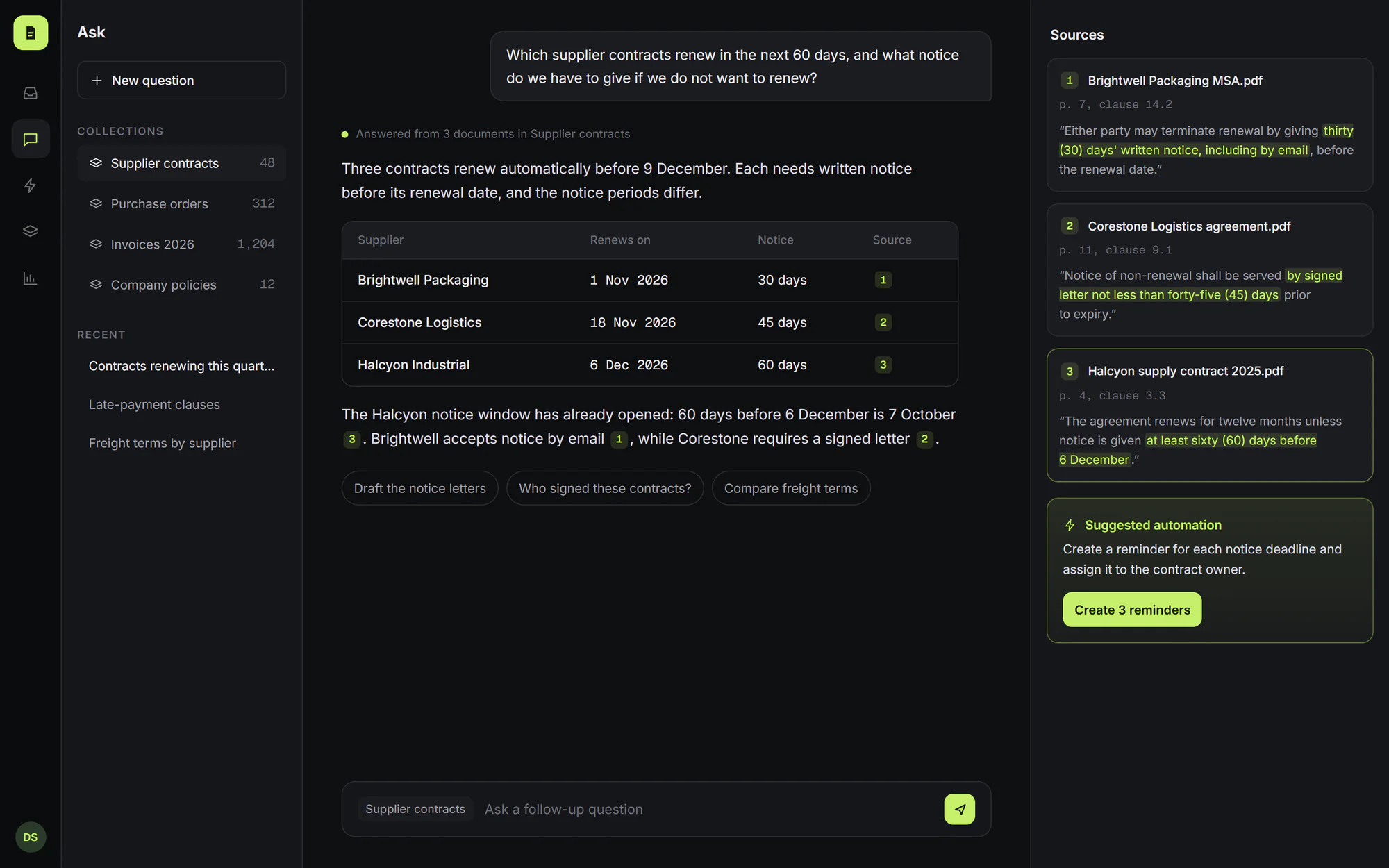
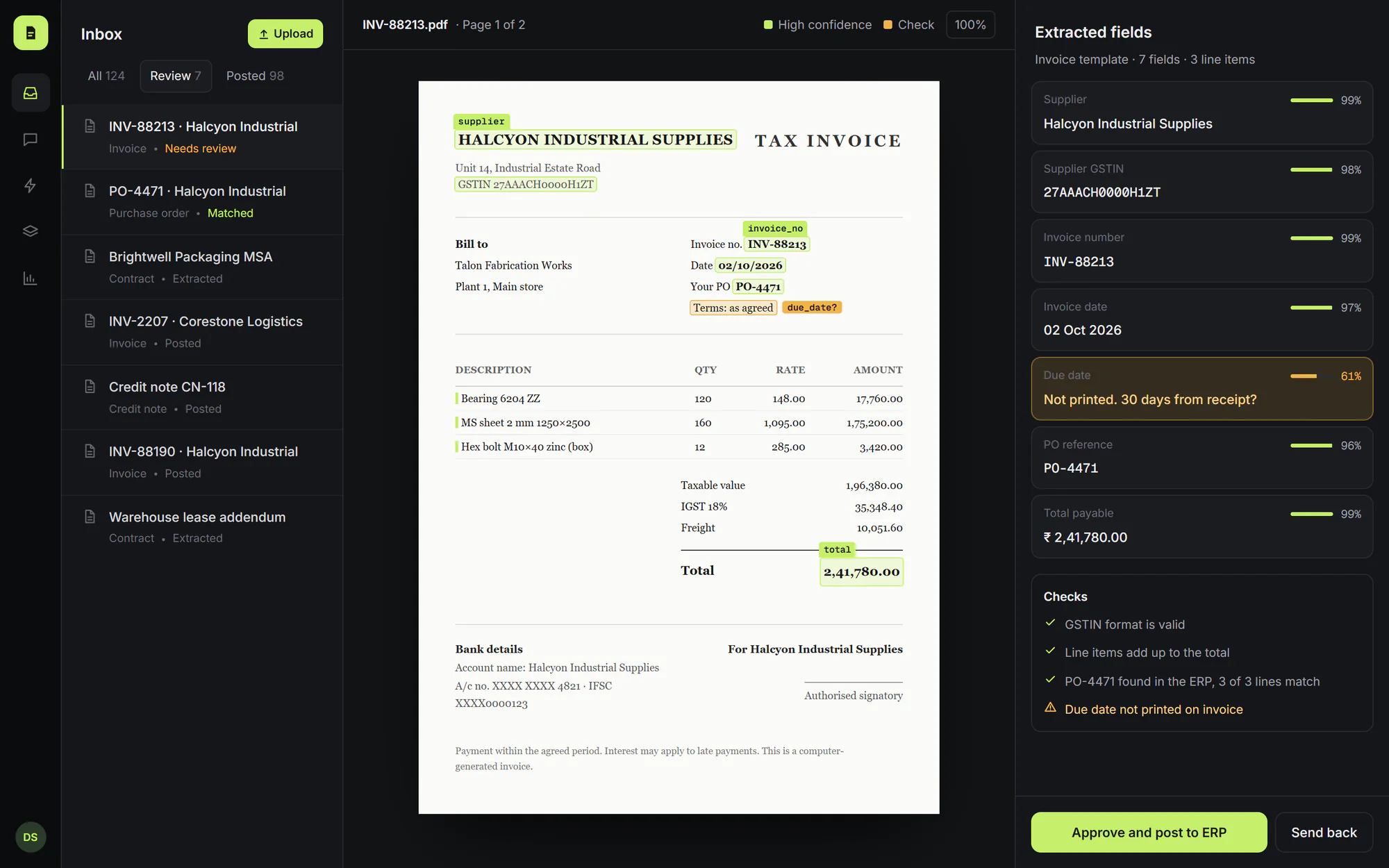
A workspace that reads invoices and contracts, extracts fields with a confidence score, checks them against the ERP, and answers questions with the source passages shown.
01Answers with cited sourcesEvery answer cites the clause it came from. 02Invoice extractionExtracted fields are highlighted on the page, with low-confidence values flagged.
07FAQ
Questions we are asked
What is the difference between an AI agent and a chatbot?
A chatbot answers questions in a conversation. An agent can also take actions with tools, such as looking up a record or creating a ticket. That extra capability calls for tighter limits, logging and review.
When does RAG make sense?
When answers should come from your own, changing documents rather than from a model's general knowledge. It tends to work best on well-organised text, and our guide covers the trade-offs.
Is our data sent to third-party model providers?
That depends on the models and hosting chosen. We document key data flows and system decisions as part of the planning process, so the trade-offs are visible before building.
How accurate will it be?
A figure cannot be responsibly promised before testing on real data. A typical approach is to build a test set from your own examples and measure what the system achieves against it.
Can AI be added to our existing software?
Often, through APIs and a defined integration point. A review of the existing system is the first step.
Have something worth building?
Tell us about the ai & automation project you have in mind. A short brief is enough to start.