
Case studyIllustrative write-up · no real client
Answers from private documents, with sources shown
An experiment in retrieval-based question answering where every answer can be checked.
- Client
- None: illustrative
- Industry
- Internal experiment
- Screens from
- Paperlane (concept)
01Challenge
The problem, as it was found
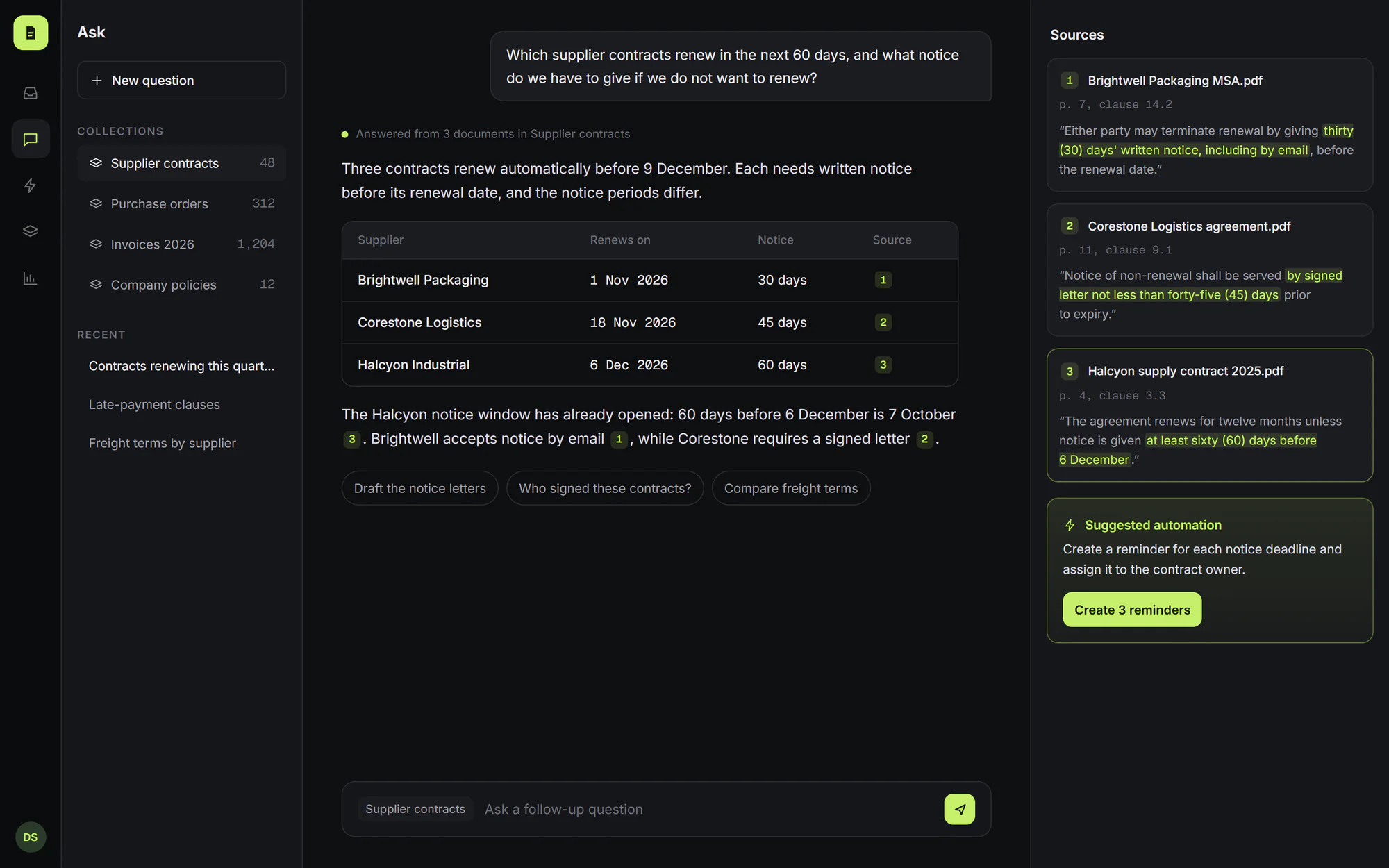
Useful answers existed in a set of private documents, but finding them meant searching files by hand, and a plain chatbot could not be trusted to stay faithful to them.
- Answers were buried across many documents
- A general-purpose assistant could state things the documents did not say
- Users needed to see where an answer came from
- The document set changed over time
Context
This was a prototype to understand what retrieval over private documents does well and where it fails, before recommending it to anyone.
The working rule was that an answer without a visible source was treated as a failure, however fluent it sounded.
02System
How it was put together
L1 · Ask and verify
Interface
- Question box
- Answer
- Source panel
L2 · Find, then answer
Retrieval
- Passage search
- Ranking
- Source tracking
L3 · Constrained generation
Model
- AI / LLM integration
- Prompt rules
L4 · Keeps the index current
Ingestion
- Splitting
- Embeddings
- Re-indexing
Path through the system
- 1Question asked
- 2Passages retrieved
- 3Answer drafted from passages
- 4Sources shown
- 5Answer reviewed
03What was built
The parts, in the order they shipped
- 01
Ingestion
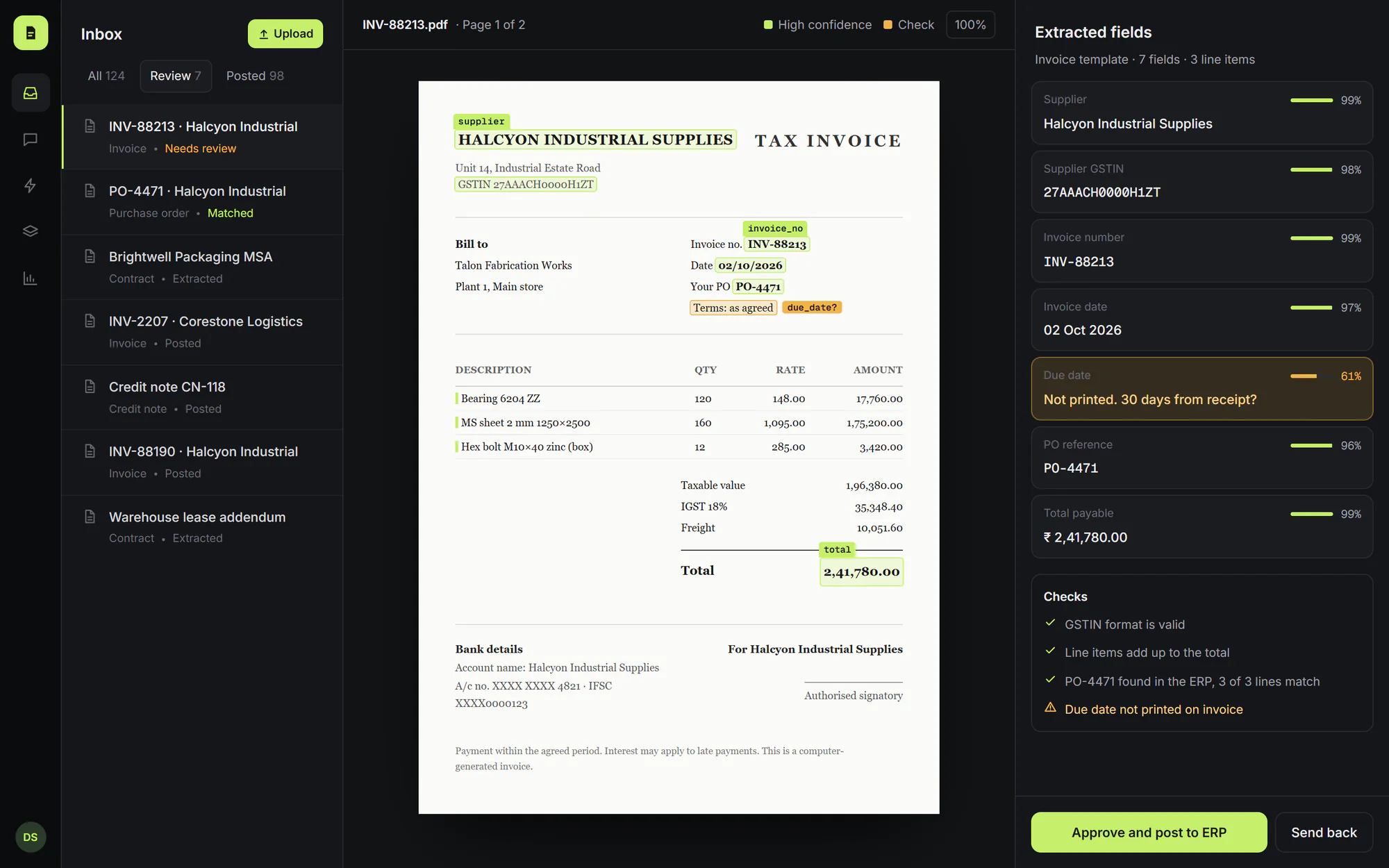
Documents are split into passages and indexed, and re-indexed when they change.
- 02
Retrieval
A question finds the most relevant passages before any text is generated.
- 03
Answer with sources
The assistant answers from the retrieved passages and shows which ones it used.
- 04
Review view
A way to compare answers with their sources and note where they fell short.
04Decisions
The choices that shaped it
Decision 1
No source, no answer
Why
An answer that cannot be traced is not useful in a setting where accuracy matters.
Trade-off
The assistant declines more often than a general chatbot.
Decision 2
Evaluate on real questions
Why
Quality can only be judged against the questions people actually ask.
Trade-off
It meant collecting examples first, before tuning anything.
Decision 3
Keep a person in the loop
Why
Retrieval narrows the risk but does not remove it.
Trade-off
Slower than a fully automated flow, and more trustworthy.
05Technology
What it was built with
- Backend
- Node.jsExpress.jsREST APIs
- Database
- PostgreSQL
- Cloud and DevOps
- Docker
- AI and automation
- AI / LLM IntegrationsRAG
06Outcome
Showed where retrieval-based answering is reliable, and where it still needs a person to check.
- Every answer links back to the passages behind it
- Questions outside the documents are declined rather than guessed
- The experiment informed how we scope retrieval projects
Demo case study. Outcomes are qualitative. No metrics, savings, revenue or user figures are claimed.
More case studies
Related
Related services
Have something worth building?
Tell us what you want to build. A short brief is enough to start the conversation.